
Alejandro Carrasco
I am an MS student on the PhD track in Aeronautics and Astronautics at MIT AeroAstro, at the ARC Lab.
My research focuses on large language models, autonomous agents, and multi-embodiment robotics training and its space use-cases.
Publications
Research publications and academic contributions
GUIDE: Guided Updates for In-context Decision Evolution in LLM-Driven Spacecraft Operations
arXiv preprint arXiv:2603.27306, 2026
VibeOps: Intelligent Spacecraft Operations Co-Pilot
AIAA SCITECH 2026 Forum, 2376, 2026
DreamSat-Bench: Development and Initial Testing of a Testbed for AI-Based Pose Estimation from 3D Reconstruction
arXiv preprint arXiv:2609.14183, 2026
Large language models as autonomous spacecraft operators in kerbal space program
Advances in Space Research, 2025
Recent trends are emerging in the use of Large Language Models (LLMs) as autonomous agents that take actions based on the content of the user text prompts. We intend to apply these concepts to the field of Control in space, enabling LLMs to play a significant role in the decision-making process for autonomous satellite operations. As a first step towards this goal, we have developed a pure LLM-based solution for the Kerbal Space Program Differential Games (KSPDG) challenge, a public software design competition where participants create autonomous agents for maneuvering satellites involved in non-cooperative space operations, running on the KSP game engine. Our approach leverages prompt engineering, few-shot prompting, and fine-tuning techniques to create an effective LLM-based agent that ranked 2nd in the competition. To the best of our knowledge, this work pioneers the integration of LLM agents into space research. The project comprises several open repositories to facilitate replication and further research. The codebase is accessible on \href{https://github.com/ARCLab-MIT/kspdg}{GitHub}, while the trained models and datasets are available on \href{https://huggingface.co/OhhTuRnz}{Hugging Face}. Additionally, experiment tracking and detailed results can be reviewed on \href{https://wandb.ai/carrusk/huggingface}{Weights \& Biases
Visual language models as operator agents in the space domain
AIAA SciTech 2025 Forum, 1543, 2025
This paper explores the application of Vision-Language Models (VLMs) as operator agents in the space domain, focusing on both software and hardware operational paradigms. Building on advances in Large Language Models (LLMs) and their multimodal extensions, we investigate how VLMs can enhance autonomous control and decision-making in space missions. In the software context, we employ VLMs within the Kerbal Space Program Differential Games (KSPDG) simulation environment, enabling the agent to interpret visual screenshots of the graphical user interface to perform complex orbital maneuvers. In the hardware context, we integrate VLMs with robotic systems equipped with cameras to inspect and diagnose physical space objects, such as satellites. Our results demonstrate that VLMs can effectively process visual and textual data to generate contextually appropriate actions, competing with traditional methods and non-multimodal LLMs in simulation tasks, and showing promise in real-world applications.
BEAVR: Bimanual, multi-embodiment, accessible, virtual reality teleoperation system for robots
2025 7th International Conference on Control and Robotics (ICCR), 283-291, 2025
\textbf{BEAVR} is an open-source, bimanual, multi-embodiment Virtual Reality (VR) teleoperation system for robots, designed to unify real-time control, data recording, and policy learning across heterogeneous robotic platforms. BEAVR enables real-time, dexterous teleoperation using commodity VR hardware, supports modular integration with robots ranging from 7-DoF manipulators to full-body humanoids, and records synchronized multi-modal demonstrations directly in the LeRobot dataset schema. Our system features a zero-copy streaming architecture achieving $\leq$35\,ms latency, an asynchronous ``think--act'' control loop for scalable inference, and a flexible network API optimized for real-time, multi-robot operation. We benchmark BEAVR across diverse manipulation tasks and demonstrate its compatibility with leading visuomotor policies such as ACT, DiffusionPolicy, and SmolVLA. All code is publicly available, and datasets are released on Hugging Face\footnote{Code, datasets, and VR app available at https://github.com/ARCLab-MIT/BEAVR-Bot.
Language models are spacecraft operators
arXiv preprint arXiv:2404.00413, 2024
Recent trends are emerging in the use of Large Language Models (LLMs) as autonomous agents that take actions based on the content of the user text prompts. We intend to apply these concepts to the field of Guidance, Navigation, and Control in space, enabling LLMs to have a significant role in the decision-making process for autonomous satellite operations. As a first step towards this goal, we have developed a pure LLM-based solution for the Kerbal Space Program Differential Games (KSPDG) challenge, a public software design competition where participants create autonomous agents for maneuvering satellites involved in non-cooperative space operations, running on the KSP game engine. Our approach leverages prompt engineering, few-shot prompting, and fine-tuning techniques to create an effective LLM-based agent that ranked 2nd in the competition. To the best of our knowledge, this work pioneers the integration of LLM agents into space research. Code is available at https://github.com/ARCLab-MIT/kspdg.
Fine-tuning llms for autonomous spacecraft control: A case study using kerbal space program
arXiv preprint arXiv:2408.08676, 2024
Recent trends are emerging in the use of Large Language Models (LLMs) as autonomous agents that take actions based on the content of the user text prompt. This study explores the use of fine-tuned Large Language Models (LLMs) for autonomous spacecraft control, using the Kerbal Space Program Differential Games suite (KSPDG) as a testing environment. Traditional Reinforcement Learning (RL) approaches face limitations in this domain due to insufficient simulation capabilities and data. By leveraging LLMs, specifically fine-tuning models like GPT-3.5 and LLaMA, we demonstrate how these models can effectively control spacecraft using language-based inputs and outputs. Our approach integrates real-time mission telemetry into textual prompts processed by the LLM, which then generate control actions via an agent. The results open a discussion about the potential of LLMs for space operations beyond their nominal use for text-related tasks. Future work aims to expand this methodology to other space control tasks and evaluate the performance of different LLM families. The code is available at this URL: \texttt{https://github.com/ARCLab-MIT/kspdg}.
DESIGN PRINCIPLES FOR EXPLAINABLE AND ADAPTIVE AI IN SPACE DIFFERENTIAL GAMES
environment 10, 11, 0
Projects
Research and personal projects exploring artificial intelligence and robotics

BEAVR - Bimanual VR Teleoperation System
Bimanual, multi-Embodiment, Accessible VR Teleoperation for diverse robotic platforms
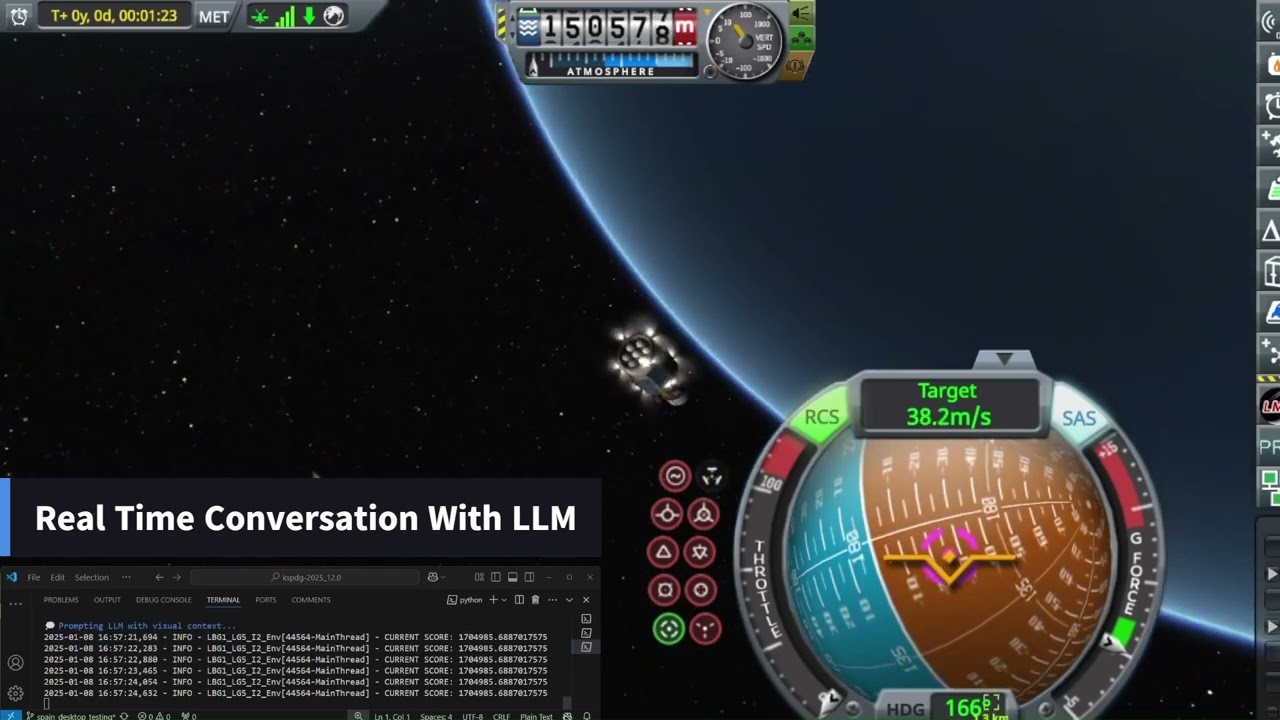
KSPDG 2026 Challenge - 2nd Place
2nd place solution for KSPDG 2026 with enhanced AI algorithms
KSPDG 2024 Challenge - 2nd Place
2nd place solution for KSPDG 2024 with autonomous spacecraft control
Trajectory
Academic & research path, MIT ARC Lab, MIT AeroAstro